Ancient Jar Icons: A Designer's Resource for Timeless Visual Storytelling
There's something quietly powerful about an Ancient Jar Icon. It carries with it echoes of craftsmanship, heritage, and the human impulse to preserve what matters. When you bring an Ancient Jar Icon into a modern project, you're not just placing a graphic—you're connecting centuries of meaning with contemporary design language. The right Ancient Jar Icons can transform an ordinary layout into something that feels grounded, storied, and intentional. For designers, content creators, and business owners searching for versatile iconography that bridges the past and the present, a comprehensive set of Ancient Jar Icons offers remarkable creative possibilities.
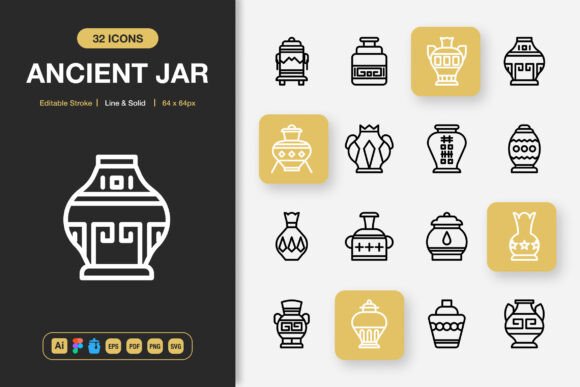
This collection represents more than just decorative elements. It provides a full toolkit of line and solid style variations, editable stroke properties, and cross-platform compatibility that adapts to virtually any creative endeavor. Whether you're designing a mobile application interface, laying out a book cover, or crafting an infographic about culinary history, these icons deliver both aesthetic appeal and functional precision. Let's explore what makes them genuinely valuable for your next project.
Understanding the Visual Language of the Ancient Jar
Jars have been part of human civilization for thousands of years. From Egyptian canopic jars to Grecian amphorae, from Ming dynasty porcelain to humble clay vessels used in everyday cooking, the jar symbolizes storage, preservation, and treasure. An Ancient Jar Icon draws on this deep well of cultural meaning. When viewers see one, they unconsciously associate it with concepts like tradition, craftsmanship, antiquity, and sustenance. That's a lot of symbolic weight for a small graphic to carry—and it does so effortlessly.
But what exactly defines a high-quality Ancient Jar Icon set? It comes down to versatility and attention to detail. The best sets offer both line style and solid style options. Line icons provide an airy, contemporary feel that works beautifully in minimalist interfaces and modern branding. Solid icons feel more substantial and grounded, ideal for badges, labels, and situations where the icon needs to hold visual weight. Having both options gives you the freedom to maintain consistency across different contexts within the same project.
Key Features That Shape the Experience
When evaluating Ancient Jar Icons for your workflow, certain technical and aesthetic qualities make all the difference between frustration and seamless integration. Here are the defining characteristics to look for:
Editable Stroke Control
This feature cannot be overstated. An editable stroke means you can adjust the thickness of icon lines without distorting proportions. Need a delicate 1px stroke for an iOS app that adheres to Apple's Human Interface Guidelines? You've got it. Need a bold 3px stroke for a poster that needs to be visible from across the room? Adjust and export. This flexibility means one icon set serves multiple purposes without requiring you to hunt down alternative versions.
High Quality and Fully Customizable
Resolution matters. High-quality Ancient Jar Icons are crafted with attention to anchor points, curve smoothness, and pixel alignment. When you zoom in, edges remain crisp. When you scale up for a large format print, the icon holds its integrity. Customization extends beyond stroke width—you can recolor, restyle, and even combine elements from different icons to create something entirely new. The icon becomes a starting point, not a limitation.
Simple Drag-and-Drop Workflow
Time is the one resource none of us can replenish. Easy drag-and-drop functionality means you can pull icons directly into your working document without wrestling with import settings or format conversions. This matters especially during rapid prototyping sessions or when a client is waiting on revisions. Streamlined workflows keep the creative momentum going.
File Formats and Their Practical Applications
The diversity of included file types reveals a thoughtful approach to compatibility. Let's walk through what each format brings to the table and when you might reach for it:
- Adobe Illustrator (.ai) — The industry standard for vector editing. Use this source file when you need maximum editability and are working within the Adobe ecosystem. Perfect for professional designers who need to make extensive modifications.
- Figma File — Increasingly essential. Figma has become a dominant tool in UI/UX design and collaborative teams. Having Ancient Jar Icons available as a Figma component library means your team can share, reuse, and maintain consistency across all screens and projects.
- Iconjar File — If you've ever struggled to manage icon collections across multiple projects, Iconjar is a game-changer. It allows you to organize, search, and drag icons directly into design applications like Sketch, Figma, or Adobe XD without ever opening a separate file browser.
- EPS Version 10 — The Encapsulated PostScript format ensures backward compatibility with older software and remains a reliable choice for print production workflows. If you're working with a print shop or using legacy design software, EPS has you covered.
- PDF File — Universally viewable and easy to share with clients or team members who may not have specialized design software. Also useful for embedding in documents, presentations, and pitch decks.
- SVG File — The backbone of web graphics. SVGs are resolution-independent, lightweight, and can be animated with CSS or JavaScript. Use SVG format for any web-based implementation of Ancient Jar Icons.
- PNG with Transparency — Sometimes you just need a quick raster image with a transparent background. PNGs are ideal for social media posts, presentations, and situations where vector support isn't guaranteed.
This breadth of format support means the Ancient Jar Icons travel easily from one environment to another. What starts as a concept in Illustrator can move to Figma for collaboration, land on a website as SVGs, appear in a printed brochure via EPS, and show up in an Instagram post as a transparent PNG—all from the same source collection.
Who Benefits from Ancient Jar Icons?
The applications are broader than you might initially assume. Let's examine some real-world personas and how they might incorporate Ancient Jar Icons into their work:
Website and Mobile App Designers
Imagine designing a recipe app that draws inspiration from Mediterranean culinary traditions. An Ancient Jar Icon could serve as the category marker for preserved ingredients, fermented foods, or spice collections. The line style keeps it clean and modern, while the subject matter adds warmth and personality. For a history museum's mobile guide, solid style Ancient Jar Icons could denote artifact galleries, with editable strokes allowing the design team to match the museum's brand weight perfectly.
Authors and Publishers
Book cover designers and interior layout artists frequently need ornamental or thematic icons. A cookbook featuring traditional preservation methods, a historical fiction novel set in antiquity, or an academic text on ancient trade routes—each could use Ancient Jar Icons as chapter markers, section dividers, or cover embellishments. The PNG format drops easily into InDesign layouts, while SVG versions can be used in ebook formats with guaranteed clarity on any screen size.
Social Media Managers and Content Creators
Visual consistency across platforms builds brand recognition. An artisan food brand could use the same Ancient Jar Icon across Instagram story highlights, Pinterest infographics, and Facebook event banners. The ability to toggle between line and solid styles means the icon adapts to the visual density of each platform while retaining the brand's identity. Add the editable stroke feature, and the icon can shift from a light, airy look on Instagram to a bolder presence on YouTube thumbnails.
Event Planners and Print Designers
From wedding invitations with a rustic theme to farmers' market flyers to restaurant menus, print applications demand high resolution and reliable color reproduction. Ancient Jar Icons in EPS and PDF formats integrate smoothly into professional print workflows. The high-quality vector construction means the icon remains sharp whether it's printed at 2 inches on a business card or blown up to 12 inches on a trade show banner.
Strengths and Considerations
Like any design resource, Ancient Jar Icons have particular strengths that shine in certain contexts, along with practical considerations worth keeping in mind.
Key strengths include the depth of cultural meaning they carry, the dual style options, and the exceptional file format coverage. The editable stroke alone saves hours of manual adjustment across different use cases. High-quality vector construction ensures longevity—you won't need to replace these icons as screen resolutions evolve or project requirements change.
In terms of practical considerations, it's worth noting that Ancient Jar Icons occupy a specific thematic niche. If your project calls for highly futuristic or abstract iconography, these may not align perfectly. They work best when your design language has room for organic forms, historical references, or artisanal character. Also, while the variety of styles and formats is generous, effective use still requires basic design literacy. Knowing when to use which style—line versus solid, thin versus thick strokes—comes with experience and an understanding of the project's broader visual hierarchy.
Evaluating Suitability for Your Project
Before integrating Ancient Jar Icons into your workflow, ask yourself a few guiding questions. Is there a thematic connection between the jar's symbolism and your project's message? Does your visual identity have space for iconography that carries historical or artisanal weight? Will users or viewers benefit from the warmth and familiarity that these icons introduce? If the answers lean positive, you've found a strong match.
Also consider the scope of your project. The collection includes enough variation to sustain consistent icon usage across large projects—multiple screens in an app, chapters in a book, or touchpoints in a brand identity system. The presence of both Figma and Iconjar files means teams can manage the icons as a shared library, reducing the risk of version conflicts or inconsistent usage.
Bringing Ancient Jar Icons into Tomorrow's Projects
There's a quiet confidence that comes from using well-designed tools. When the icons in your project are crafted with precision, delivered in every format you might need, and rooted in visual traditions that resonate with audiences, the design process becomes less about problem-solving and more about storytelling. Ancient Jar Icons invite that kind of storytelling—whether you're designing for a mobile app, a printed flyer, a social media campaign, or an illustrated book.
The included source files, from Adobe Illustrator to Figma, from SVG to PNG, mean you're never locked into a single workflow. Start in one application, refine in another, export for any destination. The editable stroke ensures visual consistency even as you adapt the icons for radically different contexts. High-quality vector construction guarantees your work looks professional at any scale.
Change how you approach your next creative project. Bring in iconography that carries history, adapts to modern needs, and performs reliably across every medium you can imagine. Ancient Jar Icons aren't just another asset pack—they're a foundation for meaningful, versatile, and enduring design.