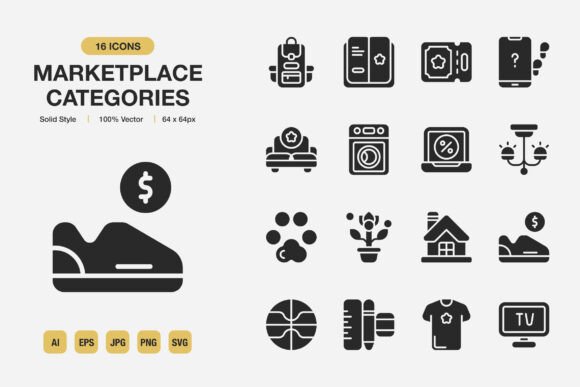
Streamline Your Visual Projects with Marketplace Categories Solid Icons
Every designer, developer, and marketer eventually faces the same frustrating moment. You have a brilliant layout in mind for a website, mobile app, or print piece, but the icons you need are scattered across different libraries, mismatched in style, or locked behind restrictive licenses. You spend hours searching, resizing, and tweaking inconsistent assets instead of building the actual product. Marketplace Categories Solid Icons were created precisely to solve this bottleneck. This cohesive icon set delivers a unified visual language that fits naturally into countless creative environments, helping you work faster and produce more polished results.
Why Visual Consistency Matters More Than Ever
Modern audiences process visual information rapidly. When someone lands on your e-commerce store, opens your app, or scans your social media graphic, the tiny details communicate professionalism before they read a single word. Icons that vary slightly in stroke width, corner radius, or overall style create subtle friction. Users may not consciously notice, but their perception of quality drops. Marketplace Categories Solid Icons address this by providing a meticulously crafted solid style that remains uniform across every symbol. Whether you select a shopping cart, a user profile, or a settings cog, the visual weight and geometry feel intentionally connected.
This consistency becomes especially critical when you manage multiple client projects or run a brand with numerous touchpoints. Using the same solid icon family on your website, mobile interface, and printed flyer builds recognition and trust. Your audience subconsciously registers the cohesion, which elevates your entire presentation.
Who Benefits Most from a Unified Solid Icon Collection
Different professionals approach icon selection with distinct priorities, yet a versatile set like Marketplace Categories Solid Icons adapts to varied workflows effectively.
- Web designers need lightweight, scalable icons that render crisply across screen sizes and maintain clarity on retina displays.
- Mobile app developers require assets that integrate smoothly with navigation bars, tab menus, and action buttons without overwhelming the interface.
- Social media managers look for attention-grabbing visuals they can drop into posts, stories, and ads without extensive editing.
- Print designers demand high-resolution files that reproduce sharply in brochures, posters, and banners, often at large dimensions.
- Content creators and educators want simple icons to illustrate infographics, e-books, and presentations without worrying about licensing complications.
Each use case demands reliability and speed. Sourcing individual icons from disparate places drains time and risks mismatched aesthetics. A comprehensive set built with consistent solid styling removes that uncertainty.
How Marketplace Categories Solid Icons Solve Everyday Design Problems
One of the most common struggles is finding icons that actually align with each other. You might locate a perfect envelope symbol on one platform, then spend 40 minutes trying to match it with a similarly styled phone icon elsewhere. Marketplace Categories Solid Icons eliminate this mismatch because every symbol originates from the same creative framework. The proportions, line thicknesses, and optical balance remain harmonious throughout the entire collection.
Another persistent headache involves file compatibility. You receive a client brief requiring vector formats for print materials, PNGs for web, and SVG for a developer. Jumping between conversion tools and hoping quality holds up is a recipe for pixelated results and wasted effort. This icon package removes that friction by including multiple file types right out of the box. The source Adobe Illustrator file lets you make deep customizations, the EPS version 10 ensures broad vector compatibility, and the SVG, JPG, and PNG transparency options cover virtually every requirement a project might throw at you.
Customization flexibility also plays a huge role. Even the best-designed icon might need a slight color shift to match a brand palette or a minor size adjustment for a particular layout. When icons are locked or flattened, you are stuck working around limitations. With access to fully editable source files, you control the outcome completely.
Practical Applications Across Different Media
The true test of any design resource is how easily it slots into real workflows. Marketplace Categories Solid Icons adapt across mediums without extra effort.
Websites and Landing Pages
Feature sections, service descriptions, and navigation elements rely on icons to guide visitors and break up text. A solid style remains readable at small sizes, which is crucial for mobile-responsive layouts. You can implement SVG files directly into your HTML, maintaining infinite scalability and reducing page load compared to bitmap images. The clean geometry of these icons complements modern minimalism, brutalism, and traditional corporate aesthetics alike.
Mobile Applications
App stores and user expectations demand refined interfaces. Icons that appear muddy or inconsistent inside a tab bar or settings menu degrade the perceived value of the entire app. Using a uniform solid set across all screens and functions reinforces your commitment to quality. Developers appreciate the drag-and-drop simplicity because assets arrive organized and ready for implementation, with transparent PNGs and SVGs that drop directly into project folders.
Social Media Graphics and Infographics
Scrolling feeds are competitive environments. Posts that incorporate clean, recognizable icons tend to stop thumbs and communicate messages quickly. Infographics especially gain from consistent iconography that simplifies complex information into digestible visual chunks. The high-quality rendering of these solid icons ensures your shared images look professional even after platform compression.
Books, Flyers, Banners, and Posters
Print demands high resolution, and scaling a poor-quality icon results in jagged edges that ruin an otherwise polished layout. Because the set includes vector formats and high-resolution JPG files, you can safely enlarge icons for posters or banners without degradation. Event flyers, instructional booklets, and trade show displays all benefit from the adaptable solid design language.
Getting Started Without Friction
Adopting a new resource should speed up your workflow, not introduce new complications. Marketplace Categories Solid Icons emphasize easy drag-and-drop handling, meaning you can locate a suitable symbol, pull it into your design software, and continue working with minimal interruption. The included documentation typically outlines where each file type is best used, saving you the guesswork of choosing between SVG and EPS for a particular task.
If you are new to working with extensive icon libraries, start by exploring the folders and identifying the 10 or 15 symbols you use most frequently. Import those directly into your current project template and test them at different sizes. Observe how the solid style maintains legibility on small mobile screens and how it holds up when printed on a flyer. This hands-on evaluation quickly reveals how much time you reclaim when you stop hunting for matching assets.
What Makes a Solid Icon Set Truly High Quality
Not all icons are crafted with the same attention to detail. High-quality solid icons exhibit thoughtful optical adjustments, not just mathematical precision. A circle and a square of identical mathematical dimensions will appear different in size to the human eye. Skilled icon designers compensate for these optical illusions, ensuring visual balance across diverse shapes. Marketplace Categories Solid Icons reflect this level of care, which is why they look natural even when displayed together in dense layouts.
High quality also means reliable file construction. Paths are clean and simplified without unnecessary anchor points, which keeps file sizes small and rendering fast. Transparent PNGs have properly anti-aliased edges that blend smoothly onto any background color. SVG code is optimized for direct web use. These technical details might seem invisible, but they determine whether your final product looks amateur or exceptional.
Customizing Icons to Match Your Brand Identity
Every brand operates with a specific color palette, and off-the-shelf icons rarely match without adjustments. The 100% customizable nature of this set puts you in command. Open the Adobe Illustrator source file, select the icons you need, and adjust fills to your exact brand hex codes. Need a slightly different corner style for a subset of symbols? The vector foundation lets you modify shapes without quality loss. This adaptability extends the lifespan of your investment because the icons grow and evolve alongside your brand guidelines.
Customization also covers scale. You might need an icon at 16 pixels for a UI button and at 200 pixels for a website hero section. Vector files handle both extremes flawlessly, so you create once and export as needed. This flexibility reduces redundant work and keeps your asset library lean.
Organizing Your Design Resources for Maximum Efficiency
Even the best icon set becomes frustrating if you cannot quickly locate the right symbol. Consider establishing a personal system where you tag or categorize frequently used icons by project type or function. Keep the SVG and PNG versions in your primary design tool's asset panel, ready for instant placement. Regular workflows benefit enormously when high-quality resources sit at your fingertips, organized and predictable.
For teams, sharing a unified icon library eliminates the visual drift that happens when different members source assets independently. Developers receive consistent SVG code, social media managers use identical symbols, and the brand presentation stays coherent across every channel. This alignment often reduces revision cycles and accelerates approval processes.
Wrapping Up Your Next Project with Confidence
Design challenges rarely come from a single difficult task. They accumulate through small frictions: reopening the same file conversion tool, settling for an icon that almost matches, redoing work after discovering a licensing issue. Marketplace Categories Solid Icons resolve many of these persistent issues before they appear. The thorough file format coverage, consistent solid styling, and unrestricted customizability equip you to handle websites, mobile apps, books, social media posts, infographics, flyers, banners, and posters with the same reliable toolkit.
When your resources support your vision instead of obstructing it, the difference shows in the final product. Projects ship faster, clients respond more favorably, and your portfolio grows stronger. That transformation begins with practical choices about the assets you bring into your workflow.