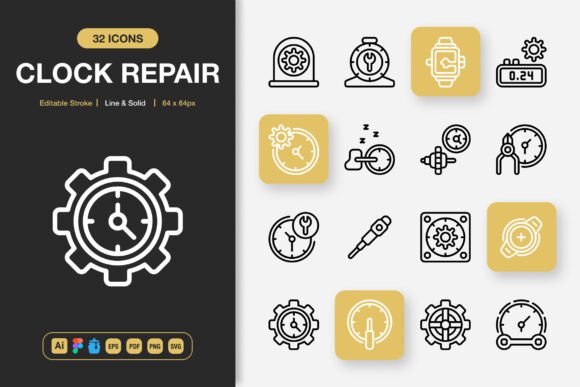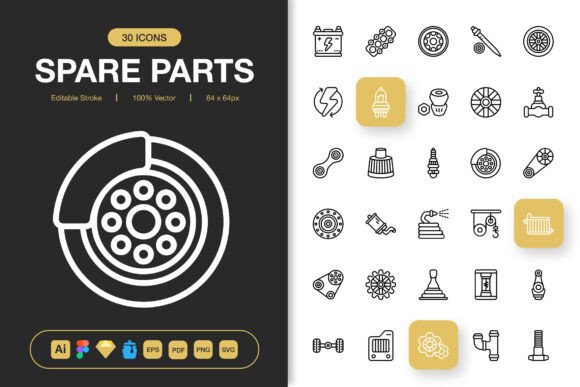
Spare Part Icons: The Ultimate Guide to High-Quality Icon Sets for Every Creative Project
In the world of digital design, icons serve as the silent communicators that guide users, simplify complex information, and add visual polish to any project. Among the many categories of iconography available today, spare part icons have emerged as an essential resource for designers working across industries — from automotive and manufacturing to tech startups and educational platforms. Whether you're building a website, designing a mobile app, or preparing print materials, having access to a versatile, high-quality icon set can dramatically accelerate your workflow and elevate your final product.
This article explores the value of spare part icon collections, what makes an icon set truly exceptional, and how you can leverage these minimalist design assets to transform your next project. We'll also dive into the technical specifications, file formats, and compatibility features that matter most when selecting the right icon library for your creative toolkit.
What Are Spare Part Icons and Why Do They Matter?
At their core, spare part icons are graphical symbols that represent mechanical components, replacement parts, tools, and industrial elements. Think of gears, bolts, nuts, screws, engine components, circuit boards, valves, springs, bearings, and similar hardware items. These icons translate physical, tangible objects into clean, recognizable digital symbols that can be used across a wide range of applications.
The significance of spare part icons extends far beyond simple decoration. In today's visually-driven digital landscape, icons function as a universal language that transcends linguistic barriers. A well-designed gear icon immediately conveys the concept of settings, mechanics, or functionality without a single word of explanation. For businesses in the manufacturing, automotive repair, or industrial equipment sectors, these icons become critical tools for communicating with customers, organizing product catalogs, and creating intuitive user interfaces.
The Growing Demand for Specialized Iconography
As digital products become increasingly specialized, the need for niche icon sets has grown substantially. Generic icon packs often fall short when designers need to represent specific industry concepts. A standard settings gear won't adequately convey the complexity of an automotive transmission system, and a generic tool icon can't differentiate between a wrench, a socket, and a ratchet. This is precisely where dedicated spare part icon collections fill a crucial gap in the design ecosystem.
Moreover, the global push toward digital transformation in traditional industries means that companies in manufacturing, logistics, and field service are investing heavily in mobile apps, web portals, and digital documentation. Each of these platforms requires clear, professional iconography that accurately represents the physical world of parts and components.
Key Features That Define a High-Quality Icon Set
Not all icon sets are created equal. When evaluating a spare part icon collection, several critical features distinguish professional-grade resources from amateur alternatives. Understanding these features helps designers make informed purchasing decisions and ensures that the icons will perform reliably across all intended use cases.
1. Editable Stroke Capabilities
One of the most valuable features in any modern icon set is the editable stroke functionality. Icons built with editable strokes allow designers to adjust the thickness of lines without distorting the overall shape. This means you can use the same icon with a thin, elegant stroke weight for a minimalist website and then increase the stroke thickness for a bold, attention-grabbing poster design — all without losing visual fidelity. Editable stroke icons are typically created using vector paths with consistent line weights, making them infinitely adaptable to different design contexts.
2. High Quality and Pixel-Perfect Precision
High-quality icons are characterized by their crisp, clean appearance at any size. Professional icon designers pay meticulous attention to pixel alignment, ensuring that icons render sharply on screens with standard resolutions. This pixel-perfect approach eliminates the blurriness and visual artifacts that plague lower-quality icon sets. Every curve, corner, and connection point is deliberately placed to maintain visual clarity whether the icon is displayed at 16 pixels or 512 pixels wide.
3. 100% Customizability
The best icon sets offer complete customizability, giving designers full control over colors, sizes, stroke weights, and even individual path adjustments. Rather than being locked into a single color scheme or style, customizable icons can be adapted to match any brand identity or design system. This flexibility ensures that your icon investment remains valuable across multiple projects and client requirements. Vector-based formats like Adobe Illustrator, Figma, and Sketch files make this level of customization possible by preserving all editable paths and properties.
4. Easy Drag and Drop Integration
Workflow efficiency matters tremendously in fast-paced design environments. Icon sets that support easy drag and drop functionality allow designers to quickly browse through a library, select the desired icon, and place it directly into their project without complicated import processes. This feature is particularly valuable in tools like Figma and Sketch, where designers can maintain organized component libraries and rapidly prototype interfaces. The time saved through streamlined icon integration adds up significantly across the lifecycle of a project.
File Formats and Compatibility: What's Included in a Professional Icon Package
A comprehensive icon set should provide designers with multiple file formats to ensure compatibility across different design tools and platforms. Here's a breakdown of the essential file formats included in professional spare part icon collections:
- Source File (Adobe Illustrator) — The original Illustrator file contains fully editable vector artwork, allowing designers to make deep customizations, adjust colors globally, and export icons in any required format. This is the master file from which all other formats are derived.
- Figma File — With Figma's rising dominance in UI/UX design, having a dedicated Figma file ensures seamless integration into collaborative design workflows. Icons are typically organized as components, making them easy to use across multiple frames and pages.
- Iconjar File — Iconjar is a specialized icon management application that helps designers organize, search, and use icon collections efficiently. Including an Iconjar file means you can quickly browse the entire icon set, search by keyword, and drag icons directly into Sketch or other compatible applications.
- Sketch File — For designers committed to the Sketch ecosystem, a dedicated Sketch file provides native compatibility and preserves symbol overrides, layer styles, and responsive resizing behaviors.
- EPS Version 10 — The Encapsulated PostScript format offers broad compatibility with older design software and print production workflows. EPS files maintain vector quality and can be placed into documents across various applications.
- PDF File — A vector PDF serves as a universal format that can be opened and used by virtually any design or document software, making it an excellent fallback option for maximum compatibility.
- SVG File — Scalable Vector Graphics files are the web standard for icons. SVG icons are resolution-independent, lightweight, and can be styled dynamically with CSS when used in web development projects.
- PNG Transparency Files — While vector formats are preferred, PNG files with transparency remain essential for quick placement in presentations, documents, and situations where vector support is limited. Professional icon sets typically include PNG exports at multiple sizes, including 32px, 48px, 64px, 96px, 128px, 256px, and 512px, covering everything from favicon dimensions to high-resolution display needs.
- Readme.txt — A well-documented Readme file provides usage instructions, licensing information, attribution requirements if applicable, and tips for getting the most out of the icon set.
Practical Applications Across Different Media
The versatility of a well-designed spare part icon collection makes it suitable for an astonishing range of creative projects. Let's explore how these icons can enhance different types of media:
Websites and Web Applications
For automotive repair shops, spare part icons can transform a basic service listing into an intuitive visual menu. Manufacturing companies can use component icons to illustrate product specifications and assembly instructions on their corporate websites. E-commerce platforms selling industrial parts benefit from clear category icons that help customers navigate extensive product catalogs. In each case, the icons reduce cognitive load and make the browsing experience more engaging.
Mobile Apps
Field service applications, maintenance tracking tools, and inventory management apps all require clear visual indicators for parts, tools, and actions. Spare part icons serve as the building blocks of these interfaces, creating intuitive navigation patterns that field technicians and warehouse workers can understand at a glance. The ability to customize icon colors also means they can align perfectly with app branding while maintaining functional clarity.
Books and Educational Materials
Technical manuals, engineering textbooks, and vocational training materials benefit enormously from precise spare part iconography. Icons help students visualize mechanical concepts, identify components in exploded diagrams, and understand the relationships between different parts of a system. Unlike photographs, which can be cluttered with irrelevant detail, clean line icons focus attention on the essential characteristics of each component.
Social Media and Digital Marketing
Companies in the industrial and manufacturing sectors use spare part icons to create eye-catching social media graphics that stand out in crowded feeds. An infographic about engine maintenance becomes more shareable and understandable when supported by relevant icons. The minimalist design aesthetic of quality icons also aligns well with contemporary social media design trends.
Infographics and Data Visualization
Complex industrial processes, supply chain flows, and maintenance schedules become significantly easier to understand when illustrated with appropriate icons. Spare part icons serve as visual anchors that help viewers quickly associate different sections of an infographic with specific components or concepts. This improves both comprehension and retention of the information being presented.
Print Materials, Flyers, and Posters
From auto repair shop promotional flyers to industrial trade show banners, spare part icons add professional polish to printed marketing materials. Because the icons are supplied as vector files, they can be scaled to any size without quality loss — meaning a small icon in a flyer can become a large graphic element on a trade show poster without any pixelation or degradation. This scalability is a defining advantage of vector-based icon sets.
The Power of Minimalist Icon Design
Contemporary design trends have firmly embraced minimalism as a guiding principle, and icon design is no exception. Minimalist spare part icons distill complex mechanical objects down to their essential visual elements, removing unnecessary detail while preserving recognizability. This approach offers several distinct advantages:
First, minimalist icons are faster to process visually. Users can identify a simplified gear or bolt icon in a fraction of a second, making interfaces feel more responsive and intuitive. Second, minimalist designs tend to age well, avoiding the rapid obsolescence that affects trendy, over-designed icon styles. Third, simple icons maintain their effectiveness across a wider range of sizes, from tiny mobile touch targets to oversized display graphics.
The minimalist approach also makes icons more versatile. A cleanly designed wrench icon can work equally well in a corporate dashboard, a children's educational app, or a vintage-style poster — the surrounding design context determines the tone, while the icon itself remains neutral and adaptable.
How Spare Part Icons Fit Into Modern Workflows
Today's design workflows are increasingly collaborative and component-based. Design systems have become standard practice in organizations of all sizes, providing a shared language of reusable components that ensure consistency across products and platforms. Spare part icon sets integrate naturally into these systems, serving as the visual vocabulary for anything related to mechanics, tools, and components.
Designers can import the complete icon set into their team's Figma library, categorize icons by function or visual style, and make them available to every team member with a single click. When the design system evolves, the customizable nature of the icons allows for batch updates to colors, stroke weights, or corner styles without manually editing each icon individually. This systematic approach to icon management saves substantial time and reduces the risk of inconsistencies creeping into the final product.
Common Misunderstandings About Icon Usage
Despite their apparent simplicity, icons can be misused in ways that diminish their effectiveness. One common mistake is using icons without accompanying text labels in critical navigation contexts. While a gear icon might seem universally understood, research has shown that text labels significantly improve usability and reduce confusion. Icons work best as reinforcements of meaning rather than sole communicators, especially in interfaces where clarity is paramount.
Another misunderstanding involves the assumption that any icon can be used commercially without proper licensing. Professional icon sets come with clear licensing terms that specify how the icons can be used, whether attribution is required, and what restrictions apply to redistribution. Always review the Readme file and license agreement included with your icon set to ensure compliant usage.
Selecting the Right Icon Set for Your Needs
When choosing a spare part icon collection, consider the breadth of the set in relation to your specific needs. A comprehensive set might include hundreds of icons covering mechanical parts, tools, fasteners, electrical components, and industrial symbols. Evaluate whether the set includes the specific icons you need for your immediate projects while also providing enough variety for future work.
Pay attention to visual consistency across the entire set. Professional icon designers maintain consistent stroke weights, corner radii, and level of detail throughout the collection. Icons from the same set should look like they belong together, creating a cohesive visual system rather than a disjointed assortment of individually styled graphics.
Finally, consider the file formats provided. Even if you currently only use one design tool, having multiple format options future-proofs your investment. Projects evolve, tools change, and team members may prefer different software. A versatile icon set with broad format support adapts to these changes without requiring you to purchase new resources.
Conclusion
Spare part icons represent far more than simple decorative elements — they are functional design assets that bridge the gap between complex mechanical concepts and clear visual communication. A high-quality, customizable icon set with editable strokes, multiple file formats, and broad compatibility empowers designers to work more efficiently while producing more polished, professional results across websites, mobile apps, print materials, and beyond.
The investment in a comprehensive spare part icon collection pays dividends through faster workflows, more consistent designs, and the flexibility to adapt to diverse project requirements. Whether you're designing an industrial e-commerce platform, creating educational content about mechanical systems, or building a maintenance tracking application, the right icons elevate your work from functional to exceptional.
With formats ranging from Adobe Illustrator and Figma source files to web-ready SVGs and transparent PNGs at multiple resolutions, modern icon sets are built to integrate seamlessly into any creative workflow. The combination of minimalist design principles, complete customizability, and extensive format support makes these icon collections an indispensable resource for designers committed to delivering their best work on every project.